Struct Lane::Classification
Defined in File osi_lane.proto
Nested Relationships
This struct is a nested type of Struct Lane.
Struct Documentation
-
struct
Classification Classificationof a lane.- Note
In the examples, the symbols l1, l2, … and lb1, lb2, … stand for the lane ids and lane boundary ids respectively, i.e. for integers (uint64). The symbols cl1, cl2, … represent the osi3::Lane::Classification::centerline elements of the lanes with the respective ids. The symbols cl1_1, cl1_2, … stand for
osi3::Vector3delements.
Public Types
-
enum
Type¶ Definition of available lane types.
Values:
-
TYPE_OTHER= 1¶ Any other type of lane.
-
TYPE_DRIVING= 2¶ A normal lane. Example: Lanes with IDs l1, l2, l3, l4 and l6 in image HighwayExit.
-
Public Members
-
optional Type osi3::Lane::Classification::type = 1 The type of the lane.
Example: For l4 in image HighwayExit the
typeisTYPE_DRIVING.
-
optional bool osi3::Lane::Classification::is_host_vehicle_lane = 2 Indicates that the host vehicle travels on this particular lane. The host vehicle may travel on more than one lane at once. This does also apply for the
CanditateLanein theDetectedLane.
-
repeated Vector3d osi3::Lane::Classification::centerline = 3 The lane’s center line (as a list of segments).
The centerline describes the middle of the lane.
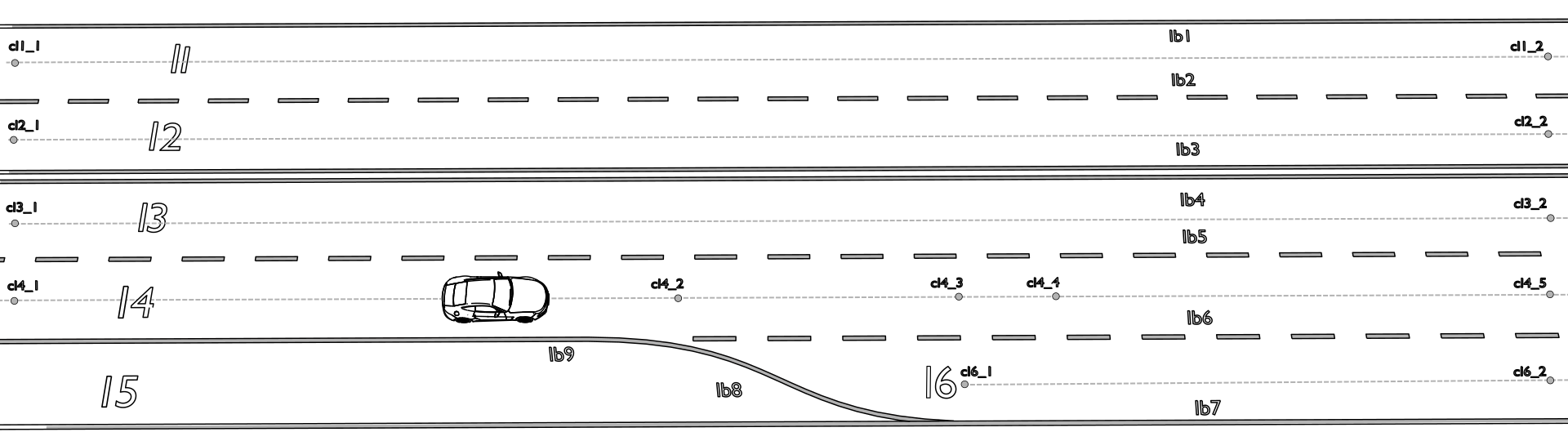
Example: In image HighwayExit, the centerline of lane l4 (black line) is given by (cl4_1, cl4_2, cl4_3, cl4_4, cl4_5).
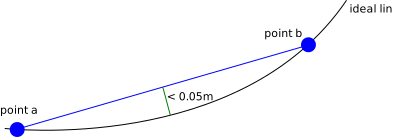
Approximation error green line.
- Attention
The points describing the center line might be set at arbitrary distances. When the points are pairwise linearly connected, the lateral distance to the real ideal line (as used by the simulation environment internally) must not exceed 5cm. As shown in the following image:
- Note
The center line is the line that a typical vehicle follows more or less (depending on the situation, a little more to the left or right of the center line). The intended direction of travel on the lane is given by the direction defined by the sequence of points forming the
centerlinew.r.t.centerline_is_driving_direction.- Note
The
centerlineis defined only fortype=TYPE_DRIVINGand if exactly one or nolane_pairingpair exists.- Note
Intersections and non-driving lanes do not have a center line. A vehicle must calculate this individually and depending on the situation.
-
optional bool osi3::Lane::Classification::centerline_is_driving_direction = 4 Definition of the intended driving direction.
Defined and used for driving lanes.
truemeans driving direction is according to ascending storage order of center line points.falsemeans driving direction is according to descending storage order of center line points.Example:
centerline_is_driving_direction=truefor lane l4 andcenterline_is_driving_direction=falsefor lane l2 in image HighwayExit .- Note
The
centerline_is_driving_directionis defined fortype=TYPE_DRIVING.
-
repeated Identifier osi3::Lane::Classification::left_adjacent_lane_id = 5 List of IDs of all lane segments that are directly adjacent to the lane on the left side (w.r.t. intended driving direction). Note that lengths of lane segments are not synchronized and therefore there are multiple adjacent segments if there is a split/merge point in the adjacent lane.
Example: The lane l3 is the only left adjacent lane for lane l4 in image HighwayExit.
- Note
The
left_adjacent_lane_idis undefined fortype=TYPE_INTERSECTION.- Note
OSI uses singular instead of plural for repeated field names.
-
repeated Identifier osi3::Lane::Classification::right_adjacent_lane_id = 6 List of IDs of all lane segments that are directly adjacent to the lane on the right side (w.r.t. intended driving direction). Note that lengths of lane segments are not synchronized and therefore there are multiple adjacent segments if there is a split/merge point in the adjacent lane.
Example:
right_adjacent_lane_id= (l5, l6) for lane l4 in image HighwayExit.- Note
The
right_adjacent_lane_idis undefined fortype=TYPE_INTERSECTION.- Note
OSI uses singular instead of plural for repeated field names.
-
repeated LanePairing osi3::Lane::Classification::lane_pairing = 7 The antecessor/successor lane pairings of this lane. There can be multiple pairings with the same antecessor and different successor lanes and vice versa. The antecessor lanes end in the same point that this lane starts from. The successor lanes start in the same point that this lane ends in.
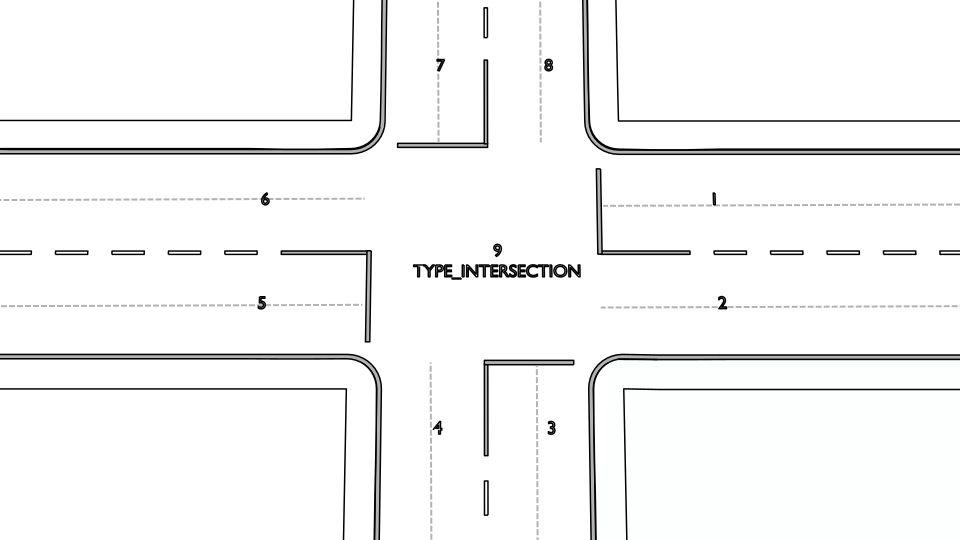
Example: See image Intersection.
- Note
OSI uses singular instead of plural for repeated field names.
-
repeated Identifier osi3::Lane::Classification::right_lane_boundary_id = 8 The right adjacent lane boundaries
right_lane_boundary_idmay only be shared with/as the left adjacent lane boundariesleft_lane_boundary_idof the nearest right adjacent laneright_adjacent_lane_id.Example:
right_lane_boundary_id= (lb9, lb6) for reference lane l4 in image HighwayExit.- Note
Empty for intersections.
- Note
The
right_lane_boundary_idis undefined fortype=TYPE_INTERSECTION.- Note
OSI uses singular instead of plural for repeated field names.
-
repeated Identifier osi3::Lane::Classification::left_lane_boundary_id = 9 The left adjacent lane boundaries
left_lane_boundary_idmay only be shared with/as the right adjacent lane boundariesright_lane_boundary_idof the nearest left adjacent laneleft_adjacent_lane_id.Example:
left_lane_boundary_id= lb5 for lane l4 in image HighwayExit.- Note
Empty for intersections.
- Note
The
left_lane_boundary_idis undefined fortype=TYPE_INTERSECTION.- Note
OSI uses singular instead of plural for repeated field names.
-
repeated Identifier osi3::Lane::Classification::free_lane_boundary_id = 10 The free boundaries which have no/unknown assignment to left/right.
Example:
free_lane_boundary_id= lb11 for lane l7 in image Intersection.- Note
Lanewithtype=TYPE_INTERSECTIONuse only free lane boundaries.- Note
OSI uses singular instead of plural for repeated field names.
-
optional RoadCondition osi3::Lane::Classification::road_condition = 11 The condition of the lane, e.g. influenced by weather.
-
struct
LanePairing The lane ID pairings of antecessor and successor lanes.
- Note
In the example, the symbols l1, l2, … stand for the respective lane ids, i.e. for integers (uint64). The symbols cl1, cl2, … represent the osi3::Lane::Classification::centerline elements of the lanes with the respective ids.
Public Members
-
optional Identifier osi3::Lane::Classification::LanePairing::antecessor_lane_id = 1 The antecessor lane ID.
-
optional Identifier osi3::Lane::Classification::LanePairing::successor_lane_id = 2 The successor lane ID.
-
struct
RoadCondition The condition of the road surface.
Public Members
-
optional double osi3::Lane::Classification::RoadCondition::surface_temperature = 1 The temperature of the roads surface in Kelvin.
Unit: [K]
-
optional double osi3::Lane::Classification::RoadCondition::surface_water_film = 2 The height of the water film on top of the surface in mm.
Unit: [mm]
-
optional double osi3::Lane::Classification::RoadCondition::surface_freezing_point = 3 The temperature where the water on top of the surface would start to freeze or dew in Kelvin.
Unit: [K]
-
optional double osi3::Lane::Classification::RoadCondition::surface_ice = 4 The percentage of ice covering the road.
Unit: [%]
-
optional double osi3::Lane::Classification::RoadCondition::surface_roughness = 5 The coefficient representing the roughness or unevenness of the road. International Roughness Index (IRI) [1] values range from 0 = smooth ground (equivalent to driving on a plate of glass) up to 20 mm/m (a very rough road).
Estimated value ranges (IRI): 0.0 [mm/m] absolutely perfect evenness 0.3 - 1.8 [mm/m] airport runways and superhighways 1.4 - 3.4 [mm/m] new pavements 2.2 - 5.7 [mm/m] older pavements 3.2 - 9.8 [mm/m] maintained unpaved roads 4.0 - 11.0 [mm/m] damaged pavements 8.0 - > 20 [mm/m] rough unpaved roads
Speed of normal use (IRI): 30 [km/h] - 20 [mm/m] 50 [km/h] - 14.5 [mm/m] 60 [km/h] - 10.0 [mm/m] 80 [km/h] - 8.5 [mm/m] 100 [km/h] - 3.4 [mm/m]
Road conditions (IRI); 15 [mm/m] erosion gulleys and deep depressions 11 [mm/m] frequent shallow depressions, some deep 9 [mm/m] frequent minor depressions 5 [mm/m] surface imperfections
Unit: [mm/m]
- References:
[1] SAYERS, M.W.; KARAMIHAS, S.M. Little Book of Profiling, University of Michigan Transportation Research Institute, 1998.
-
optional double osi3::Lane::Classification::RoadCondition::surface_texture = 6 The surface texture or fine roughness
Whereas the IRI-based roughness or unevenness measure only takes into account road wavelengths around 0.5m - 100m, the surface texture or fine roughness [2] measures only wavelengths below 0.5m. It is given as the standard height deviation of fine roughness
Unit: [m]
- References:
[1] SAYERS, M.W.; KARAMIHAS, S.M. Little Book of Profiling, University of Michigan Transportation Research Institute, 1998.
[2] SCHNEIDER, R.: Modellierung der Wellenausbreitung fuer ein bildgebendes Kfz-Radar, Dissertation, Universitaet Karlsruhe, Mai 1998.
-